
Sunday, December 31, 2006
Underground Video Footage of Saddam's Execution
This one I hacked from a Middle-East TV channel...I am not defending or supporting US's stand on this but is it virtue to hang a Muslim on EID!!! One more thing check the last portion of this footage some brutal maniacs kicked his dead body.
Absolutely crap...

Happy New Year to You All
Hi Wishing you all a very happy and prosperous new year. In 2007 may all your wishes come true and enjoy every second of 2007.
Dreamer a.k.a. Abhi
Dreamer a.k.a. Abhi
Wednesday, December 27, 2006
Is it Reservation for weakers?or Reservation to make Weaker?
 Students and junior doctors of Sir Sunderlal Hospital in the Banaras Hindu University (BHU) on Tuesday went on a strike to protest against a lathicharge against anti-reservation protesters.
 The medicos alleged that the guards injured seven students who were collecting signatures at the university gate against the reservation policy.
Doctors didn’t report for duty and students boycotted classes to press for their demand that the guards and officials responsible for the lathicharge be punished. This was the second time in a week that the doctors and students have gone on strike.
The medicos will step up their agitation against the Centre’s decision to reserve 27 per cent seats in higher educational institutions for other Other Backward Classes (OBCs), said a student leader.
Guys have you seen the movie Rang De Basanti? Power and politics didn't defend the youth force...don't you feel one more RDB we need? Just raise your voice against the brutality of those crap vote-monger politicians. Reservation won't help backward classes to move up front it will handicapped them for their lifetime.
Friday, December 22, 2006
Anti-Child Labour Law: See The Other Side of Coin
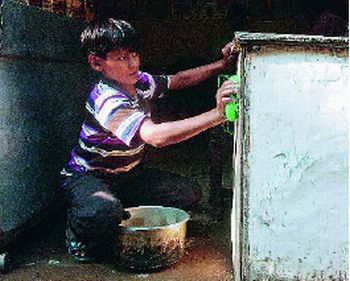
The new Anti-Child Labour law may have come to the rescue of many underage working children in the country but as the media has been constantly reporting, the law has made survival more difficult for some others.
For instance, 12-year-old Birendra Kumar is orphaned and already on his second job.
He is the face of the other side of the Anti-Child Labour law, a side that makes more vulnerable exactly those it is supposed to protect.
Birendra's new job is at a Patna dhaba - washing dishes and serving tea.
He lost his first job which was in a cloth showroom as the owner of the shop didn't want to keep him once the law came into force.
"I used to work in a cloth store and used to earn Rs 1000 a month. I lost that job and now I work at a tea stall,” says Birendra.
His new job pays him half of what he used to earn earlier, only Rs 500. With that, he not only has to fend for himself but he has to take care of his four-year-old sister as well.
"We don’t have parents,” says Birendra’s sister, Chutki.
In eyes of law, Birendra is still an offender and so is his employer but he has to continue working to earn money that keeps him and his sister alive.
He knows he is defying a law that has been much talked about but he also realizes that he has little choice.
"We are in dire straits. We want to go to school but we don’t have the money,” he says.
Locals have little to offer but pity for the children. “He is the only earning member of the family. They will starve if he stops working,” says a local resident, Ranjeet Kumar.
There are thousands of Birendras and Chutkis for whom this law is not a boon and even those who are in the crusade of enforcing the law hardly look beyond the rule books.
So this is a request to the Lawmakers please think twice before imposing any law on society. I am not a supporter of child labour but before imposing any law we should provide an environment which could preserve that law. Our society still not provided any other alternative to those poor children so how could we expect anything good?Thursday, December 21, 2006
Gender Equality: The Untouched Goal of Indian Workforce
Gender equality is yet to be a reality for the Indian workforce. If women’s participation in top management is to be seen, it is pathetically low, with just 3% of the senior positions in the private sector being filled by them. In the public sector, 5-6% is occupied by women, according to an ICICI Bank presentation made at an Aima conference for ‘Women In Leadership Roles’, in New Delhi last week.
Globally, women’s presence in boardrooms has improved. Poonam Barua, regional director, The Conference Board, a US-based research firm, said: “The number of Fortune 500 companies with 25% or more women on their boards has increased from 11-64% from 1995-2005.”
Overall, in India, women’s participation in the workforce has grown to 31% in 2005 from 26% in 2000. The growth has been more in the rural areas with 34% compared to 26% urban participation, according to Roopa Purushothaman, chief economist of the Future Group.
Given the talent crunch and the need for creating a quality resource pool, firms are hiring a number of women. It was the need of the hour that was helping reduce gender inequality, experts said.
“The services sector has been the growth engine for the Indian economy. Its share of GDP has grown to about 52% in 2004-05 from 41% in 1990-91. Of the existing base of 85 lakh workers in the organised sector, 30% will retire within five years,” said Madhabi Puri Buch, head (operations), ICICI Bank.
Globally, women’s presence in boardrooms has improved. Poonam Barua, regional director, The Conference Board, a US-based research firm, said: “The number of Fortune 500 companies with 25% or more women on their boards has increased from 11-64% from 1995-2005.”
Overall, in India, women’s participation in the workforce has grown to 31% in 2005 from 26% in 2000. The growth has been more in the rural areas with 34% compared to 26% urban participation, according to Roopa Purushothaman, chief economist of the Future Group.
Given the talent crunch and the need for creating a quality resource pool, firms are hiring a number of women. It was the need of the hour that was helping reduce gender inequality, experts said.
“The services sector has been the growth engine for the Indian economy. Its share of GDP has grown to about 52% in 2004-05 from 41% in 1990-91. Of the existing base of 85 lakh workers in the organised sector, 30% will retire within five years,” said Madhabi Puri Buch, head (operations), ICICI Bank.
Cultivate me if you want...
What to say about myself…hmmm….people call me talkative but I call myself expressive as talkative persons can at least express their mind and are not introvert. By profession I am a techie and by passion I am a person who loves to meet strangers…my blog helps me to fulfill my passion. I am blogging since Nov’2006 and till now I have met lots of strangers through my blog. Meeting new people adds your experience about knowledge and as my blog suggests Knowledge Never Deceives, I believe one day this knowledge will surely help you in your life.
OMG, I have written many heavy words like a philosopher…hey there I am not a philosopher, I am fun loving person…let’s take a look about my liking and disliking…
I like...
Simplicity
Innocence
Enjoying life with friends
Java Programming (I just love it man)
Internet (can’t think a day without it)
Teasing people with my silly jokes…
Any fast pace movie
Any spicy non-veg food
Reading books and blogs
Meeting strangers…
And about my disliking…
Hypocrisy
Smoking (although I use to it at times but trying to get over it)
Poverty and starvation
Child Labor
Sexual Harassment
Racism...
To know about my likings and disliking please go through my blog, you will come across lots of unfolded aspects of my life…
OMG, I have written many heavy words like a philosopher…hey there I am not a philosopher, I am fun loving person…let’s take a look about my liking and disliking…
I like...
Simplicity
Innocence
Enjoying life with friends
Java Programming (I just love it man)
Internet (can’t think a day without it)
Teasing people with my silly jokes…
Any fast pace movie
Any spicy non-veg food
Reading books and blogs
Meeting strangers…
And about my disliking…
Hypocrisy
Smoking (although I use to it at times but trying to get over it)
Poverty and starvation
Child Labor
Sexual Harassment
Racism...
To know about my likings and disliking please go through my blog, you will come across lots of unfolded aspects of my life…
Wednesday, December 20, 2006
Amartya Sen on Indian Child Labour and Gender In-Equality
Although India has witnessed social progress, serious challenges still remain - including the most important one of child deprivation, Nobel laureate Amartya Sen said here Tuesday.
Speaking at a lecture on Child and Human Rights, Sen said: "There has been social progress in India but some serious problems still face the country - the most important among them being child deprivation and under-nourishment."
"There have been numerous programmes for the undernourished children but they have failed to create an impact. This disturbing picture needs rapid remedy," the renowned economist said while launching the Indian Journal of Human Development by the Institute for Human Development.
"Under-nourishment and lack of medical assistance have enhanced this growing problem (child deprivation). Thus we have to look forward to a broader framework to address deprivation of Indian children," he added.
He stressed that human rights activists needed to address children's deprivation in particular.
"Incorporating a legal system has certainly helped human rights. The idea of human rights can be used in other ways. The legislature can help to promote an ethical way of human life. The Supreme Court of India can help promote this as they have in the past," Sen said.
Referring to the issue of gender inequality and resulting child under-nourishment, he said: "Gender inequality casts a shadow on child under-nourishment right from the time the child is in the womb. And an undernourished child always has the propensity to cardio-vascular diseases."
Touching upon female foeticide, he said such cases were decreasing elsewhere in the world but rising alarmingly in India and it needed to be seriously addressed.
Subscribe to:
Posts (Atom)
